






Active Power Filters for Regenerative Testing of Industrial Power Converters: Prima Electro’s Approach
Innovation Driven by Advanced Testing
At Prima Electro, innovation goes beyond the design of customized power electronics solutions. It naturally extends to advanced testing and product validation, which play a key role in ensuring long-term reliability.
End-of-line testing represents a crucial stage in the life cycle of an industrial power converter: it is the moment when performance, robustness, and reliability are verified before commissioning.
For this reason, within our manufacturing facilities we operate high-efficiency regenerative testing systems, fully designed in-house by our R&D team. These systems enable full-power testing of converters across all critical operating conditions, while simultaneously reducing the overall energy consumption of the production plant.
The flip side: Harmonics
Regenerative test systems for AC–AC industrial power converters are widely adopted thanks to their ability to feed energy back into the grid. However, this architecture also introduces a significant challenge: harmonic distortion.
Harmonics generated during testing can degrade power quality, negatively affect nearby loads, and increase electrical stress on plant components. In complex industrial environments, where multiple power electronic systems operate simultaneously, this issue becomes particularly critical.
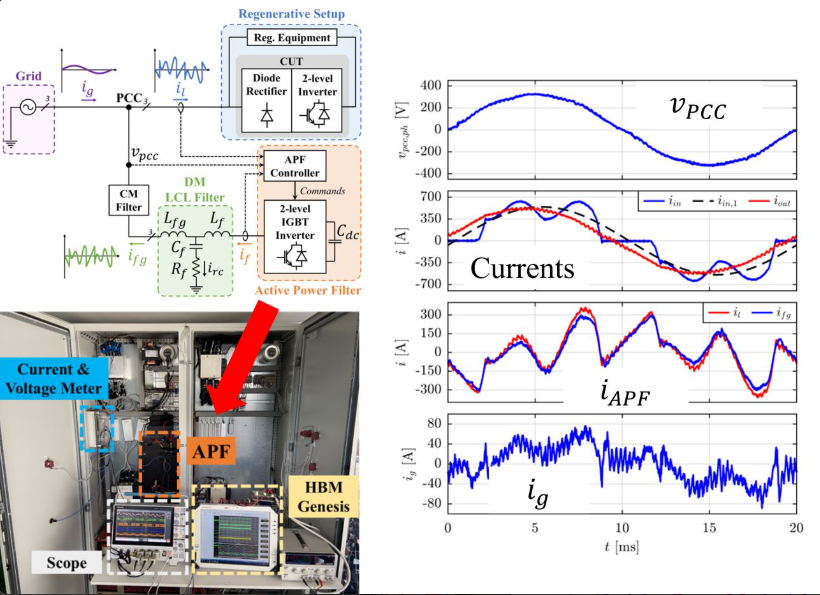
To address this challenge, all Prima Electro test benches are equipped with Shunt Active Power Filters (APFs) specifically designed to suppress low-frequency harmonics produced by the converters under test.
The development of these APFs was not approached as a purely theoretical exercise, but as a concrete industrial engineering challenge. The filters had to be reliable, disturbance-robust, energy-efficient, and cost-effective, even under demanding operating conditions.
Applied Research in Collaboration with PoliTO
These development activities were carried out in collaboration with the Power Electronics Innovation Center (PEIC) at Politecnico di Torino, resulting in an applied research project that successfully combines academic rigor with real industrial constraints.
The outcome of this collaboration has been published in the IEEE Open Journal of Industry Applications and provides practical design guidelines for Active Power Filters (APFs) specifically developed for industrial regenerative testing systems.
In particular, the paper investigates a modulation strategy capable of:
- reducing overall system losses;
- improving operational robustness,
- limiting stress on power semiconductor devices;
- reducing the impact on grid-interface filters.
All results are supported by experimental validation, a fundamental step to ensure that the proposed solutions can be effectively transferred from the laboratory to real manufacturing environments. This work represents a concrete example of how industry–academia collaboration can generate meaningful innovation: solutions that are not only theoretically sound, but also truly applicable in complex industrial production settings.
For Prima Electro, investing in applied research means strengthening process quality, improving product reliability, and contributing to the development of increasingly efficient and sustainable power electronics technologies
Read the full article on IEEE Xplore
Related news
What makes us what we are